Node - Athena
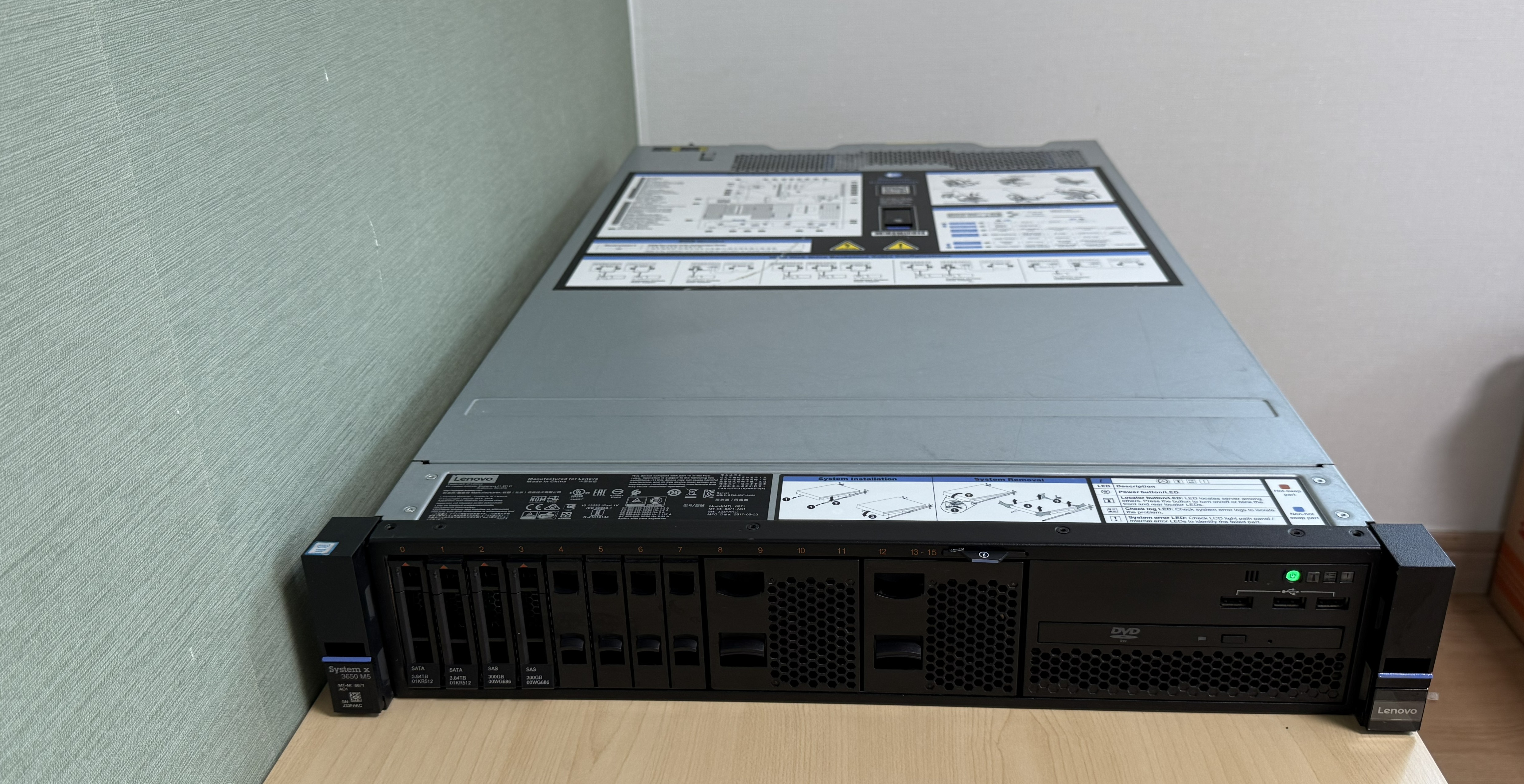
Compute / AI / VM Host node built on a Lenovo System X3650 server






For the full cluster architecture, see the Home Server Infrastructure Overview.
At a Glance
| Item | Value |
|---|---|
| Role | Compute / AI · LLM / VM Host |
| Hardware | Lenovo System X3650, dual Xeon E5-2630 v4 (20 cores / 40 threads total), 272 GB RAM (16 GB × 17) |
| GPU | NVIDIA Tesla P100 × 2 |
| Storage (local) | Local VM disk (NVMe 1 TB) + Hades NAS mount |
| OS / Hypervisor | XCP-ng (Xen) |
| Network (IP) range | 192.168.200.X |
| Public ports | 1 WireGuard port |
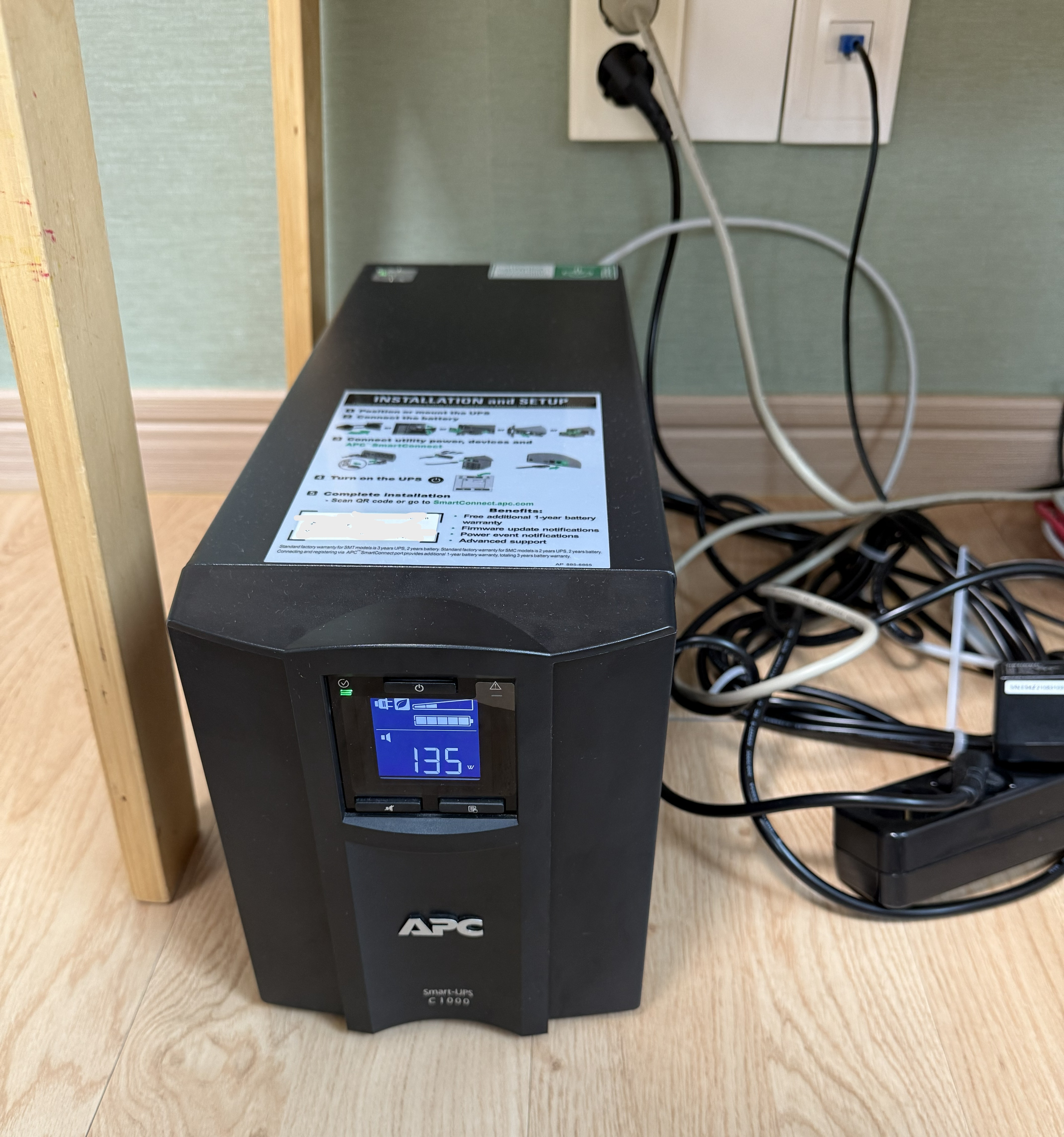
| Power protection | APC UPS SMC1000 (1000 VA) — holds 10+ min at a typical 400 W peak; the VPN VM detects and propagates power loss |
| In service since | 2024 onward |
| Current status | Running (compute node) — ~254 days of continuous uptime since the UPS was added (booted 2025-10-04) |
One-line summary: Athena is the compute-only node that runs per-project VMs and GPU workloads side by side on a single machine.
What Runs Here
Athena’s base unit is “one VM per project → dependency isolation with Docker inside the VM.” It is designed so a package conflict or runtime problem in one project never affects another.
| Type | Purpose | Resources |
|---|---|---|
| JupyterHub VM | Notebook environment for data analysis / model experiments | vCPU 8, RAM 32 GB, 1× P100 passthrough |
| LLM / AI experiment VM | Local LLM inference (Ollama) and fine-tuning experiments | vCPU 8, RAM 32 GB, 1× P100 passthrough |
| Infrastructure VM | WireGuard VPN endpoint (incl. outage detection/propagation), XOA for XCP-ng management | vCPU 4, RAM 4 GB |
Past project VMs
| Project | Description | Period | Resources |
|---|---|---|---|
| Frontier | Ontology service collecting/storing data from multiple channels (Slack, Notion, Discord, etc.), hosting PostgreSQL, Neo4j, Qdrant | 2025.12 ~ 2026.04 | vCPU 8, RAM 32 GB |
| Communicare | Backend prototype server for an international-student community platform, hosting PostgreSQL | 2025.10 ~ 2025.12 | vCPU 4, RAM 8 GB |
| TACTIX | RAG system for an air-gapped environment | 2025.05 ~ 2025.06 | vCPU 8, RAM 32 GB, GPU P100 |
| Moisam | Moisam backend prototype server, hosting MySQL | 2025.04 ~ 2025.05 | vCPU 4, RAM 8 GB |
Deployment pipeline (for service VMs)
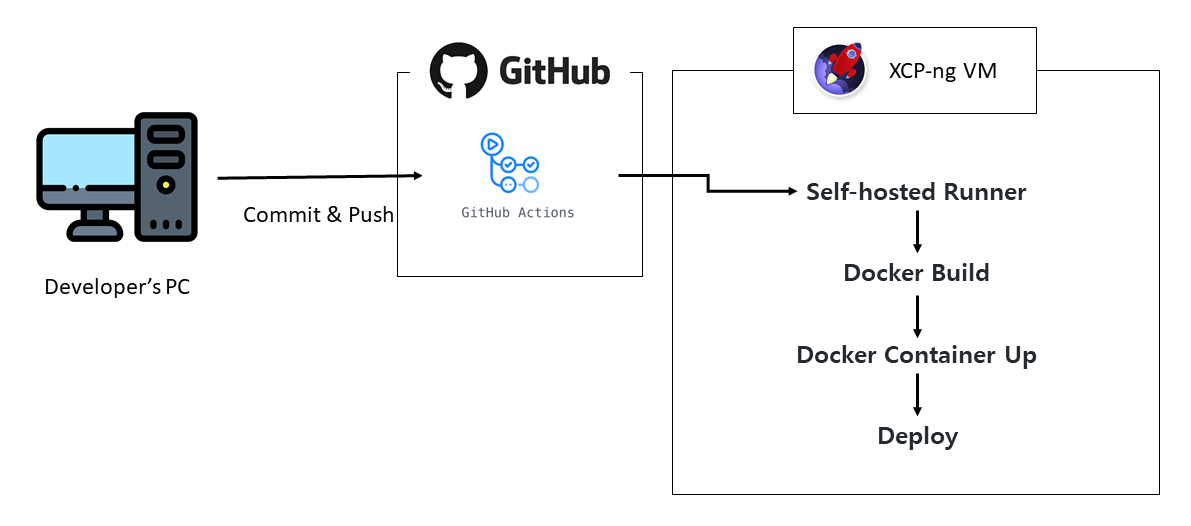
A GitHub Actions self-hosted runner sits inside an Athena VM, so commit → build → container swap happens automatically without opening any build port externally.
Storage usage
- VM OS disks: local to Athena
- Project data / models / datasets: mounted from the Hades NAS (over WireGuard)
- Container data: regenerable data is excluded from backup; only long-term data is copied to the NAS backup path
Key Decisions
- Why XCP-ng (Xen)
Athena is a 20-core machine, which exceeds the free ESXi license’s 8-vCPU limit. I evaluated Proxmox and XCP-ng as alternatives and, since Hades already ran ESXi, chose XCP-ng because its management model is closer to ESXi. Keeping both nodes’ operations (snapshots, console access, VM migration) similar reduces operational overhead.
- Trade-off considered: Proxmox is KVM-based with strong ZFS integration and plenty of Korean resources, but I preferred unifying on XCP-ng over paying the cognitive cost of moving away from the ESXi-style workflow.
- Why Docker on top of VMs (instead of Docker alone)
Docker alone already isolates dependencies. The reason for wrapping it in a VM as well:
- Guaranteed resource limits: vCPU/RAM/disk caps are set at the VM level so one project’s OOM or runaway disk usage cannot affect the whole host.
- GPU passthrough: dedicating a Tesla P100 per VM (rather than container sharing) is easier for managing driver/CUDA version conflicts.
In return, I accept some inefficiency from double virtualization (hypervisor + Docker). As services grow, moving to a single plane such as VM consolidation / Kubernetes is planned as the next step.
- Why JupyterHub
Analysis/experiment workflows are often notebook-based, and I did not want to copy notebooks back and forth between laptop and server. JupyterHub lets Athena’s GPU resources be used directly from the notebook environment — that is the core reason.
Operations & Incidents
Routine operations
- Take per-VM snapshots manually, before and after major changes
- Keep project data on the NAS mount path, included in Hades’s daily backup
- WireGuard keys are separated per node — Athena exposes only 1 external WireGuard port
- The VPN VM monitors UPS (APC SMC1000) status and, on power loss, propagates the alert to the other VMs
Power protection (UPS)
- Device: APC UPS SMC1000, 1000 VA output
- Load basis: the Lenovo X3650’s hardware can draw up to ~1.8 kW at peak, but a UPS that sustains that level is too expensive to be practical. Instead I sized for the real-world peak of a normal workload, ~400 W, rather than the extreme of GPUs at full load. The UPS’s goal is not uninterrupted operation but securing enough time to shut down safely.
- Target protection window: configured to hold 10+ minutes at 400 W → a window to save in-progress work and shut down safely on power loss (the window shrinks under full GPU load, so on an outage signal, training jobs are stopped first)
- Detection & propagation: the UPS is connected over USB to Athena’s WireGuard / VPN VM. When the UPS raises an external-power-cut alert, the VPN VM receives it and propagates it to Hades, Daedalus, and the other nodes → the whole cluster enters a coordinated safe-shutdown
Incident — forced shutdown from an outage & GPU kernel corruption (the reason the UPS was added)
Situation: a power outage in the area around Athena forced a hard shutdown. External power was restored about 45 minutes later.
How I noticed: the boot after power was restored looked fine, but as a GPU workload came up, nvidia-smi failed to recognize the device and CUDA calls failed. Tracing the kernel log, I found the NVIDIA driver’s kernel module was corrupted.
Response:
- Removed and reinstalled the NVIDIA driver at the same version, rebuilt the kernel module, and GPU workloads recovered.
- Concluding that the forced shutdown itself had to be prevented, I added a UPS — installing the APC SMC1000 (1000 VA).
- Attached the UPS to the VPN VM over USB and built the outage → VPN-VM detection → propagation to other nodes structure.
- Organized per-VM shutdown commands to gracefully stop GPU workloads and training jobs on outage detection.
Lesson: power is the essential foundation that makes the whole system operable. Separately from data backup, a “sudden outage” itself can leave state damage on accelerators like GPUs. And a single node’s outage response is only meaningful when it propagates across the whole cluster.
Result: the same failure has not recurred since the UPS was added, and the node has run without a reboot for ~254 days (~8 months) since the 2025-10-04 boot. There were a few brief outages in that span, but the UPS absorbed them and the system stayed up. (Based on the current uptime reading, with no time-series logging.)
Incident — environment drift
Over long-running operation, unused Docker images and old VM snapshots accumulated and the disk filled up. After that I added “clean up once every two months” to the operational routine.
Limitations & Next Steps
What’s missing now
- No GPU scheduler, so allocation relies on manual agreement
- Weak self-hosted-runner isolation — worked around by a policy of not accepting external PR builds
- No monitoring/alerting → VM state is checked by a person directly
What I’ll change next
- Visualize GPU/memory usage with Prometheus + node_exporter + nvidia_gpu_exporter
- Strengthen isolation by running the self-hosted runner as a single-use container
- Evaluate a lightweight scheduler (Slurm or Ray, etc.) for queuing heavy training jobs
Photo
Korean version: Node - Athena